Preventive Maintenance for Industrial Robots: How to Keep Your Motoman Running at Full Capacity A practical guide to Preventive Maintenance (PM) planning for Yaskawa Motoman robots
Time-based maintenance schedules, techniques to extend service life, and strategies to reduce unplanned downtime on the production area.
In today's manufacturing plants, industrial robots typically run 16–24 hours per day and are at the core of the production line. Even a few hours of unplanned downtime can result in losses ranging from hundreds of thousands to millions of Baht — especially in high-speed line industries such as automotive, food and beverage, or electronics.
The good news is that over 70% of robot-related downtime can be prevented with proper Preventive Maintenance (PM). This article summarises how to maintain for your Motoman — from daily inspections to encoder battery and grease replacement at defined intervals — so your robots operate at full capacity throughout their 10+ year service life.
Why Preventive Maintenance Matters More Than You Think Many factories still rely on a "Run-to-Failure" approach — use the robot until it breaks, then fix it. This is more costly than it appears, because it often overlooks the indirect costs associated with production stoppages, emergency spare parts, and after-hours repairs. Compared to a scheduled PM programme, the total cost of Run-to-Failure is typically 3–5 times higher.
< Swipe left or right to view more >
| Factor |
Run-to-Failure |
Preventive Maintenance |
| Downtime |
Unpredictable — can be days or weeks |
Planned — typically 2–4 hours per session |
| Spare Parts Cost |
High due to rush orders |
Ordered in advance at standard prices |
| Service Life |
5–7 years before replacement |
10–15 years or more |
| Safety |
Risk of sudden failure and accidents |
Issues detected early |
| Work Quality |
Performance gradually declines with wear |
Stable, matching design spec |
| Total Cost (5 years) |
Approximately 3–5× higher than PM |
Predictable — plan budget in advance |
Motoman Maintenance Schedule by Interval YASKAWA recommends a PM approach tailored to operating frequency and the robot’s Operating Hours. A maintenance log should be maintained for every activity to ensure full traceability.
🔹 Daily Check Takes only 5–10 minutes at the start of each production shift. Can be assigned to the line Operator on duty to help detect early anomalies and reduce the risk of unplanned stoppages.
• Alarm/Error: Check for errors and abnormalities via the Teach Pendant screen
• Emergency Stop: Test the E-Stop button to ensure the safety system is functioning normally
• Power & Signal Cables: Visually inspect all cables — no signs of damage, breakage, twisting, or being pinched
• Sound during motion: Listen for unusual noises from the Servo and Gear / Reducer units while the robot is running
• Alignment Mark: Check the Second Home position and Alignment Marks — must be aligned on every axis
• Work area & robot arm: Clear obstructions around the work area, and inspect the exterior; wipe off dust, oil residue, or check for cracks
• Tool / Gripper: Check that the end-of-arm tool bolts and gripper are securely fastened and ready for use
🔹 Weekly PM Checklist
For trained technicians
• Base mounting bolts: Use a Torque Wrench to verify and re-tighten the robot base bolts to the specified torque value
• Encoder Battery: Check for battery alarms to prevent loss of axis position data
• Safety System: Test the Interlock system to ensure the safety circuit is functioning normally
• TCP Accuracy: Run a Test Position to verify the accuracy of the Tool Center Point
• Grease Leakage: Inspect for grease leaks around the robot's axis joints
• Sensor: Perform an I/O Check on the Input / Output signals to confirm sensor operation
• Backup Program: Back up robot data and programs to a USB or CompactFlash (CF) Card
🔹 Monthly PM Checklist
For trained technicians
• Grease Leak: Inspect for grease leaks around the robot's axis joints
• Servo Motor: Check operating temperature and heat build-up, and listen for unusual sounds during motor operation
• Gearbox: Run a Job at low speed to inspect Backlash and the robot's response
• Cooling Fan: Check the rotation and operation of cooling fans
• Control Cabinet: Remove and clean the dust Filter of the control cabinet
• Electrical System: Inspect and measure the Input voltage
• Pneumatic System: Perform a Leak Test to detect leaks in air lines, fittings, valves, cylinders, Solenoid Valves and Fittings
• TCP Calibration: Verify the accuracy of the Tool Center Point
🔹 Annual Maintenance (6,000 hours) Performed by a YASKAWA-certified engineer or partner System Integrator, as it involves opening the robot housing and following specific procedures.
• Electrical System & Battery: Measure the supply voltage to the control cabinet, and the battery voltage of both the controller and the robot itself
• Lubrication & Mechanical System: Replace or replenish grease at each joint, inspect for metal particles in the grease, check the belt condition, and torque bolts at specified points
• Motion System & Motor: Check motor balance, inspect play and vibration of the gear reducer units, verify Servo condition using Hicoder, and run the robot continuously for 30 minutes – 1 hour
• Connectors & Devices: Check motor Connectors and inside the control cabinet, inspect the cabinet fan, and test the operation of the Hold and E-Stop buttons and the Teach Pendant
• Data & Housekeeping: Record operating hours, back up data (Data Save), and clean the exterior of the control cabinet, fan, and Teach Pendant
🔹 Long-Term Maintenance (12,000 / 24,000 / 36,000 hours) Major service intervals that require consumable replacement and advance planning, since some items must be imported from Japan.
< Swipe left or right to view more >
| Interval (hours) |
Key Activities |
Every 1 year
(6,000 hours) |
Annual Maintenance: Grease injection and replacement (Grease) at every axis joint to lubricate the mechanical system |
Every 3 years
(18,000 / 36,000 / 54,000 hours) |
Replace worn parts on interval: Replace batteries (Robot & Controller), dust Filter Kit, and Key Sheet to prevent data loss |
Year 5
(30,000 hours) |
Major Overhaul #1: Replace belts, cooling fans, internal power/signal cables, gear Reducer units (heavy-load axes), and begin preparing Spares for the control boards |
Year 7
(42,000 hours) |
Drive system inspection: Inspect and replace Servo Motors or the Wrist Unit based on actual usage condition |
Year 10
(60,000 hours) |
Major Overhaul #2: Another round of major parts replacement — cabling, cooling system, and gear Reducer units — to extend service life over the long term |
Note: If the production line frequently handles Heavy Duty workpieces or runs continuously at high speed, mechanical parts and cables may wear out faster and require service before the standard hour intervals.
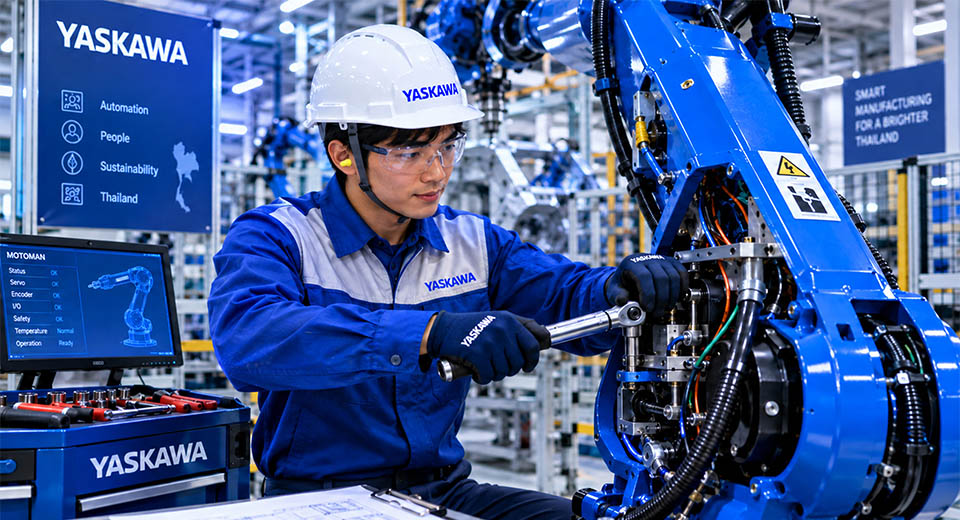
*AI-generated image for illustrative purposes only. Actual products may differ from those shown.
Warning Signs You Should Never Ignore If you observe any of the following, do not wait for a breakdown — contact your maintenance team or Yaskawa Service immediately, as they may indicate the early stages of a larger problem.
• Unusual motor or gear noise: Grinding, squealing, or jerky sounds — especially during direction changes
• Declining repeatability: Positions that should be exact drift by 0.5–1 mm or more
• Abnormally high temperatures: Servo motors or Controller running hot, possibly from fan failure or clogged air filters
• Recurring alarms on the same axis: Overload or Position Error alarms repeating on one axis
• Gear oil leaks: Oil residue around joints or under the base — often caused by seal degradation
• Visible cable wear: Cracks, tears, or fraying at the most frequently bent points
YASKAWA ELECTRIC (THAILAND) — Your Long-Term Maintenance Partner YASKAWA ELECTRIC (THAILAND) has a team of Japan-certified Service Engineers based at the Bangkok Head Office and the Chonburi Service Branch, covering the EEC and other regions nationwide. Beyond PM, services include Emergency Support, Spare Parts Stock, Training Courses, and Retrofit for legacy robots.
Plan Your Spare Parts Stock Consultation Systematically Contact the CS-R Sale Service Engineer department [email protected] or Technical Hotline Service (Line Official) @yaskawathai
❓ FAQ – Frequently Asked Questions about Preventive Maintenance for Motoman Robots
How often should Preventive Maintenance be performed?
Divided into 2 levels:
- Customer / user self-inspection — Daily, Weekly, Monthly
- Service by YASKAWA / Licensee Person — referenced by the specific Motoman model and its manual, since intervals may differ slightly between models
How long does the Motoman encoder battery last?
• The battery has a service life of 3 years
Can our in-house team perform PM on their own?
• Customers who have been trained by YASKAWA can perform PM themselves
For training course inquiries, please contact [email protected]
What is the typical annual PM cost for a Motoman robot?
• Approximately 4 hours per unit
The cost of PM depends on the robot model and service day, starting at 20,000 THB per unit
Should we use Original YASKAWA Parts or third-party alternatives?
• Original Parts are strongly recommended — especially encoder batteries, gear oil, and internal robot cables — because they are designed to meet Motoman specifications. Third-party parts may void the warranty and reduce long-term reliability.
What signs indicate the robot "needs urgent service"?
If any of the following abnormalities are observed, stop and inspect the robot, then notify the Technical team for prompt evaluation:
• Alarm notifications appearing on the Teach Pendant
• Unusual sounds while the robot is moving or operating
• Abnormal operating accuracy — such as position drift or motion that is not as expected
You can send the details and symptoms to the YASKAWA Technical team for a free preliminary assessment, via LINE Official: @yaskawathai
Does YASKAWA offer Service Contracts?
• YASKAWA offers Preventive Maintenance (PM) services for robots, with inspection schedules and formats that can be tailored to each factory's needs — helping to maintain robot condition and reduce the risk of production downtime.
For PM Robot service or further information 📧 [email protected]

 Contact us
 Email
Email
