Why Thailand's Automotive Industry Is Accelerating Robot Adoption for EV Production
An inside look at industrial robot investment on Thailand's EV production lines
Understand the government policies, the technical challenges, and how to select Yaskawa Motoman robots for Battery Assembly, Welding, and Handling work in EV factories.
Thailand has long been the largest automotive production base in ASEAN, with peak output exceeding 1.8 million vehicles per year and more than 20 global automotive brands operating factories in the country. The transition from internal combustion engine (ICE) vehicles to electric vehicles (EVs) is now reshaping the industry across the board, and one of the clearest impacts is a rapid acceleration in industrial robot investment at every stage of the production line.
Over the past 2–3 years, major EV manufacturers from China, Japan, and Europe have announced production bases in Thailand's Eastern Economic Corridor (EEC), with combined investment reaching hundreds of billions of baht. Every one of these facilities uses automation at a significantly higher ratio than traditional ICE plants. This article looks in detail at why EV production depends on robots to a much greater degree, and how Thai manufacturers should prepare.
Thailand Is Shifting From "Detroit of Asia" to "EV Hub of ASEAN"
The Thai government has set the Thailand 30@30 target, which requires 30% of vehicles produced domestically to be electric vehicles by 2030. That is equivalent to producing around 725,000 EVs per year, backed by several support measures designed to attract investment from international manufacturers.
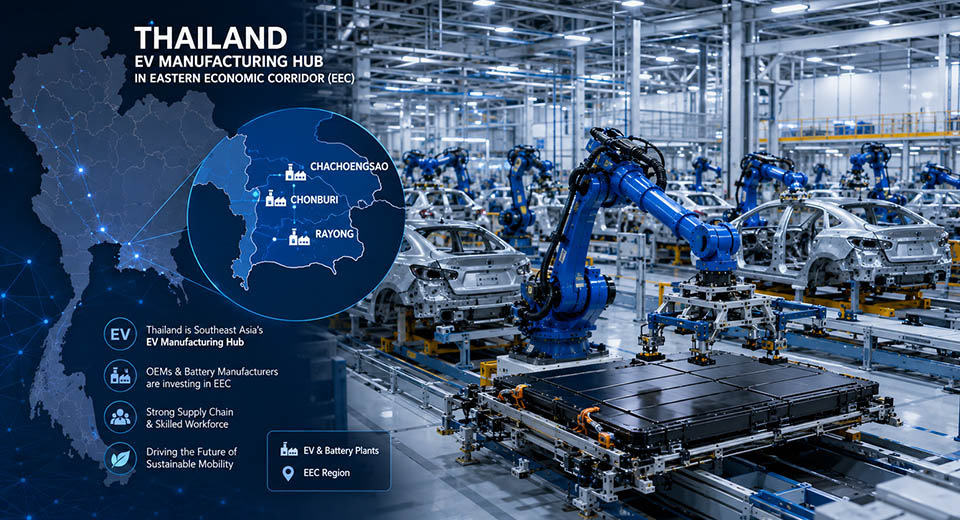
Key policies and measures shaping robot investment in EV production include:
< Swipe left or right to view more information >
| Policy / Measure |
Key Points |
| 🎯 Thailand 30@30 |
Sets the target that 30% of vehicles produced in Thailand will be EVs by 2030. |
| 🎯 EV3.5 measures |
Buyer subsidies, excise tax reductions, and local production requirements to offset import volumes. |
| 🎯 BOI Incentives |
Corporate income tax exemptions of up to 8 years for investments in EVs, batteries, key components, and automation systems. |
| 🎯 EEC Zone |
Strategic zone in Chonburi, Rayong and Chachoengsao where the major EV manufacturers have located their plants. |
| 🎯 Robot & Automation Measures |
Additional tax deductions for investments in robots and automation systems produced domestically. |
The impact is clear: since 2022, major Chinese EV manufacturers such as BYD, MG (SAIC), Great Wall Motor, GAC AION, Changan, Chery and Neta have announced production bases in Thailand, while Japanese manufacturers such as Toyota, Honda, Isuzu, Nissan have also reconfigured existing lines and invested in new EV production lines here.
Why EV Production Requires More Robots Than ICE Production
A reasonable question is: if Thailand has produced ICE vehicles for decades using mostly human labour, why should EV production be so much more dependent on robots? The answer lies in the fundamentally different nature of the parts and processes involved.
< Swipe left or right to view more information >
| Factor |
ICE Vehicle |
EV |
| Body Material |
Mostly steel; MIG/Spot welding is straightforward. |
Aluminum and mixed-material bodies requiring Laser Welding and Friction Stir Welding. |
| Battery |
Small 12V battery; can be installed by hand. |
400–800V traction battery weighing 300–600 kg; must be lifted and installed by robots. |
| Safety |
Standard risk profile. |
High-voltage electrical shock risk and thermal runaway if assembled incorrectly. |
| Required Precision |
±0.1 – 0.5 mm. |
±0.02 – 0.05 mm, especially for Busbar welding and cell placement. |
| Clean Room |
Not required. |
Battery Cell Assembly must operate in humidity- and dust-controlled environments. |
| Number of Parts |
Approximately 20,000–30,000 parts. |
Reduced to around 10,000–15,000 parts, but with far greater electrical and chemical complexity. |
These factors mean that many tasks on the EV production line cannot be performed safely or cost-effectively by hand. They require robots with high precision, fine torque control, and the ability to operate in specialised environments such as clean rooms or high-voltage zones.
Yaskawa Robot Applications for EV Production Lines
🔹 1. Battery Assembly
Traction battery assembly is divided into three main levels: Cell → Module → Pack. Every stage demands high precision and cleanliness.
• Cell Sorting & Loading: Compact robots such as the GP4 or GP7 pick up cylindrical or pouch cells and place them into assembly slots at high speed with precisely controlled gripping force.
• Module Assembly & Stacking: The GP12 or GP25 assembles sub-modules together and drives screws to specified torque values.
• Battery Pack Assembly: The GP110, GP180, or GP225 lifts packs weighing 300–600 kg into position beneath the vehicle body — work that humans cannot safely perform.
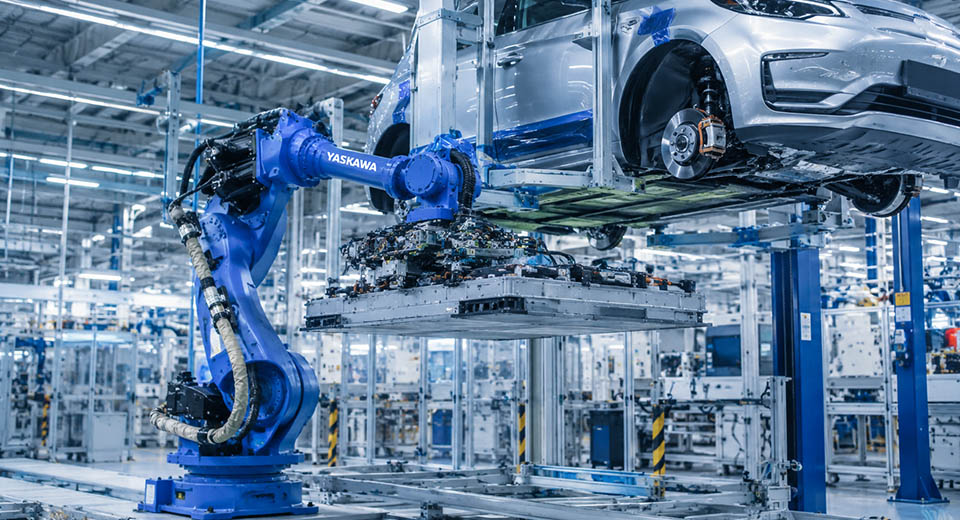
🔹 2. Body Welding
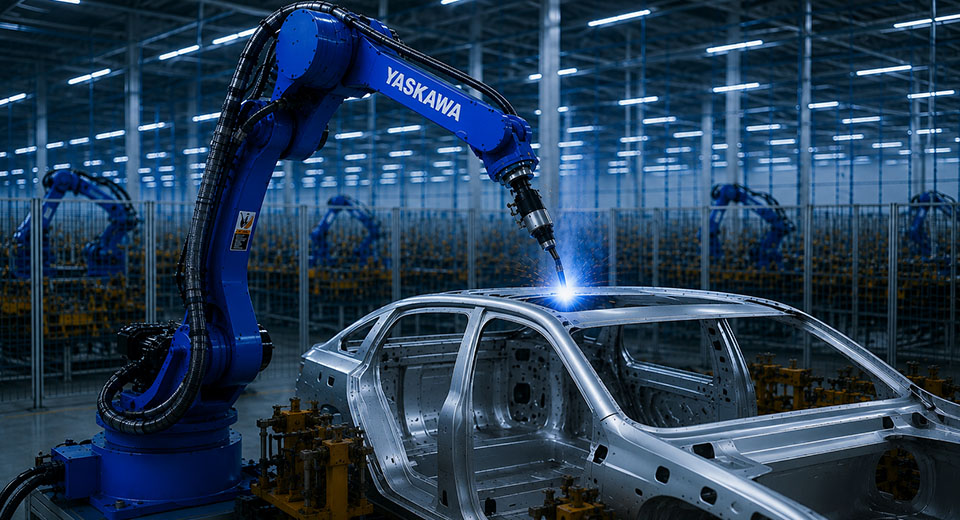
Many EV bodies rely on aluminum to reduce weight and offset the added mass of the battery. Aluminum welding is significantly more challenging than steel because porosity forms easily and heat must be controlled with precision.
• MIG/TIG Welding for Aluminum: Motoman AR series (AR700, AR900, AR1440, AR2010) paired with the Yaskawa Welding Interface and dedicated arc-control software.
• Laser Welding: Supports integration with laser heads for welding Battery Tray and Busbar assemblies.
• Spot Welding: Larger GP-series models handle Servo Gun tools weighing several tens of kilograms for body-in-white welding.
🔹 3. E-Drive & Motor Assembly
An E-Drive unit combines the electric motor, Inverter, and Gearbox into a single assembly weighing roughly 80–150 kg. Building it requires robots that combine strength with precise positioning.
Recommended models: GP88 or GP110 paired with a Force Sensor for Precision Assembly work that requires controlled press-fit forces on delicate components.
🔹 4. Final Assembly & Material Handling
End-of-line operations — installing wheels, glass, and doors, connecting wiring, and running End-of-Line (EOL) tests — are handled by conventional robots or, in some stations, Cobots (Collaborative Robots) working alongside human operators in flexible layouts.
Recommended Yaskawa Robots for EV Production Lines
< Swipe left or right to view more information >
| Production Station |
Task |
Recommended Model |
| Battery Cell Handling |
Pick-and-place cells into modules |
GP4 / GP7 / GP8 |
| Battery Module Assembly |
Stack modules and drive screws |
GP12 / GP25 |
| Battery Pack Handling |
Lift 300–600 kg packs into position under the vehicle |
GP180 / GP225 / GP400 |
| Aluminum Body Welding |
MIG/TIG for aluminum |
AR900 / AR1440 / AR2010 |
| Laser Welding |
Battery tray and Busbar welding |
GP25 / GP50 + Laser Head |
| Spot Welding (Body-in-White) |
Spot welding on steel body panels |
GP88 / GP110 / GP180 |
| E-Drive Assembly |
Motor + Inverter + Gearbox |
GP88 / GP110 + Force Sensor |
| Sealing / Dispensing |
Adhesive and waterproof seal on battery |
GP12 / GP25 |
| Final Assembly & EOL |
Wheels, glass and end-of-line tasks |
GP50 / GP88 / GP110 |
Challenges for Thai Manufacturers and How to Prepare
The opportunity is real, but Thai automotive parts manufacturers — particularly Tier-1 and Tier-2 suppliers — face several challenges:
• Shortage of automation engineers: The market needs thousands of engineers capable of setting up and maintaining robot systems, but the talent pipeline has yet to catch up.
• High initial investment: A fully integrated robot cell can cost anywhere from a few million to tens of millions of baht per station.
• Rebuilding legacy processes: Tier-1 suppliers that historically produced ICE components must reconfigure most of their lines to serve EV demand.
• Battery supply chain: A domestic network of battery and related materials producers still needs to be built.
Yaskawa Electric (Thailand) has engineering teams and System Integrator partners across the country ready to assess your production line, calculate ROI, develop a Proof of Concept, and train your in-house technicians for long-term robot operation.
Evaluating ROI for Robot Investment on EV Lines
Factors to consider when calculating ROI for robot deployment on EV production lines:
< Swipe left or right to view more information >
| Cost Factor |
Details |
| ⚡ Lower labour cost |
Reduces staffing at stations with repetitive, hazardous, or physically heavy tasks. |
| ⚡ Consistent quality |
Reduces defect rate in welding and battery assembly, lowering long-term warranty costs. |
| ⚡ Higher production capacity |
Faster cycle times and 24/7 operation without breaks. |
| ⚡ Safety |
Reduces high-voltage and heavy-lifting accidents, lowering insurance costs. |
| ⚡ Tax incentives |
BOI privileges and deductions available for robot investment. |
| ⚡ Typical Payback Period |
Usually 2–4 years, depending on production volume and process complexity. |
The Future of Thailand's EV Industry: Why Start Investing Today
Over the next 3–5 years, global EV competition will intensify significantly, particularly from Chinese manufacturers with strong cost advantages. Thai manufacturers who want to remain competitive have limited alternatives:
👉 Raise quality to world-class standards through automation with consistent quality control.
👉 Reduce cost per unit by improving production efficiency.
👉 Build production line flexibility to support faster model and variant changes.
👉 Prepare for export to markets with high standards such as Europe and Japan.
Starting robot investment today is not simply about purchasing machinery — it is about building institutional knowledge that will become a strategic asset over the next 5–10 years.
Yaskawa Electric (Thailand) is ready to be a partner for Thai manufacturers transitioning to the EV era.
With more than 100 years of Yaskawa Group experience and over 600,000 Motoman robots installed worldwide, backed by in-country support from our Bangkok Head Office and Chonburi Service Branch, our engineering team can support you from feasibility assessment and cell design through installation, training, and long-term maintenance.
❓ FAQ – Common Questions About Robots on EV Production Lines
Why does EV production use more robots than ICE production?
• Because EV production involves heavy components (Battery Pack 300–600 kg) and hazardous conditions (400–800V high-voltage electrical systems) that exceed what humans can safely handle. It also requires the high precision of aluminum welding and battery cell assembly, tasks that rely on robots with accuracy in the ±0.02 mm range.
Where should Tier-1 suppliers in Thailand begin their EV robot investment?
• Start with an analysis of your Product Mix and identify bottlenecks first. Most EV parts manufacturers begin with Battery Module Assembly, Busbar welding, or Battery Tray lifting — tasks that deliver high ROI and also carry the highest safety risks.
Does Yaskawa offer dedicated robots for EV applications?
• Yaskawa has a complete robot family covering every step of EV production: the Motoman GP Series for handling and assembly, the Motoman AR Series for aluminum arc welding, and the Motoman HC Series (Cobot) for tasks where humans and robots work side by side. All are controlled by the YRC1000 controller with Coordinated Motion capability.
How does aluminum welding differ from steel welding?
• Aluminum welding is significantly more challenging because aluminum conducts heat well, requires higher energy, and porosity forms easily without careful heat control. It calls for robots that finely manage the arc, together with technologies such as Pulsed MIG or Cold Metal Transfer (CMT). Yaskawa's Motoman AR Series supports a Welding Interface designed for this work.
What is the typical payback period for robot investment on an EV production line?
• Typically 2–4 years, depending on production volume, task complexity, and local wage levels. High-volume work running 2–3 shifts per day can pay back in under 2 years, while lower-volume operations with a wide SKU mix may take longer.
Do we need automation engineers in-house?
• For the initial installation, Yaskawa and our System Integrator partners handle the work. Over the long term, the plant should have at least 1–2 in-house engineers for Preventive Maintenance, teach-point adjustments, and first-line troubleshooting. Yaskawa runs training programmes designed specifically for factory personnel.
How should SME manufacturers with limited capital begin EV robot investment?
• We recommend starting with a single-station Pilot cell, choosing the task with the clearest ROI — for example, welding battery components or lifting modules — and expanding as the team gains experience. Take full advantage of BOI privileges and tax deductions for robot investment, which can reduce the initial burden significantly. The Yaskawa Thailand team is available for free consultation. Contact us at www.yaskawa.co.th/contact

 Contact us
 Email
Email
