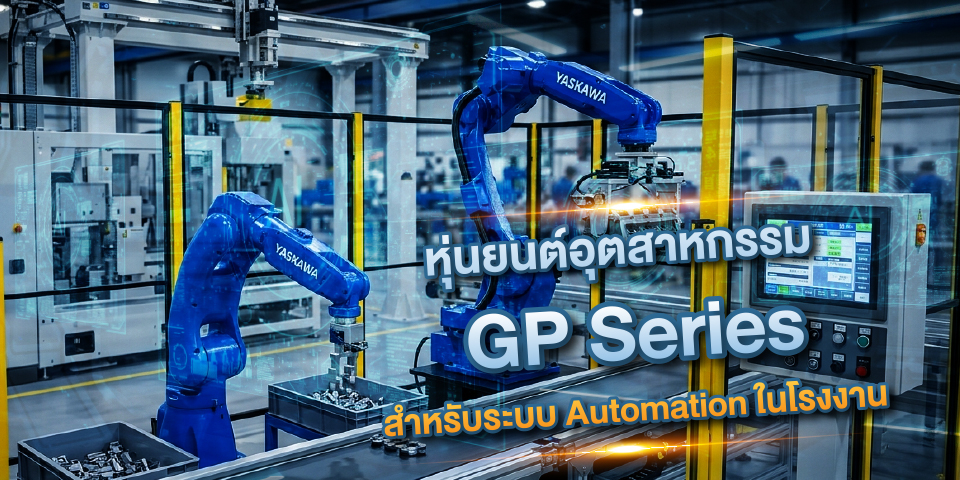
Industrial Robot GP Series | Automation for Automotive & Manufacturing

Post date : April 30, 2026

Industrial Robot GP Series for Factory Automation

Robot Automation Solutions for Every Industry
•  Boost production capacity by up to 2x
•  Reduce labour costs with industrial robots


Robot Automation solutions for the Automotive, EV, Plastic and Electronics industries
Covers every task from small components to heavy-duty factory operations.


Application examples across industries

< Swipe left or right to view more information >

Industry Recommended GP Models Applications Task Characteristics
Automotive / EV • GP25
• GP50
• GP88
• GP180
• GP250
• Body welding
• Automotive parts handling
• EV battery pack frame
• Press machine loading
• Heavy-duty
• Large parts
• Durable
• Continuous operation
Electronics Industry • GP4
• GP7
• GP8
• GP10
• GP12
• GP25-12
• Pick & Place of small components
• PCB / electronics assembly
• Packaging of electrical devices
• Small to medium parts
• High speed required
• High precision
• Short cycle time
Plastic Industry
(Injection / Packaging / General)
• GP7
• GP8
• GP10
• GP25
• GP50
• GP88
• Load parts into CNC machines, injection moulding machines, and presses
• Pick parts from moulds
• Runner cutting / trimming
• Mid-size parts, varied by part size
• Flexibility required across tasks

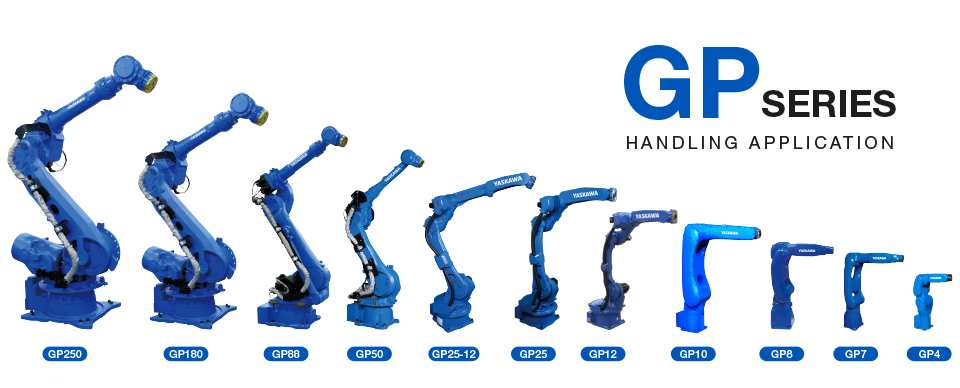
The GP Series supports every industrial application
GP4 | GP7 | GP8 | GP10 | GP12 | GP25 | GP25-12 | GP50 | GP88 | GP180 | GP250


YASKAWA Motoman GP Series industrial robots for automotive, electronics and plastic industries

The GP Series covers a full payload range from 4 kg to 250 kg, supporting a wide range of applications across the automotive, electronics, and plastic industries.

Factory challenges that Robot Automation solves
•  Labour shortages and rising wage costs
•  Production capacity unable to keep up with demand
•  Inconsistent product quality
•  High defect rates driving up costs
•  Need to increase output but limited by floor space


✨ Manual processes = costs that are hard to control and shrinking profits over the long term ✨

Replace manual labour with Robot Automation
✅  24/7 operation
✅  Millimetre-level accuracy
✅  Reduced defects
✅  Immediate boost to hourly output


Benefits of using robots in the factory
⭐  Higher productivity: typically 15–40% (depending on the type of work and production process)
⭐  Reduced defects: around 10–30%, especially for precision-critical tasks
⭐  Reduced reliance on manual labour: around 20–30% in repetitive or hazardous work
⭐  ROI (payback period): typically 1–3 years on average, depending on investment cost and production volume


Why choose the GP Series
▶︎  Full payload range from 4 kg to 250 kg
▶︎  Supports every industry
▶︎  Engineering team available for consultation and system design tailored to your production process
▶︎  After-sales service included


Factories that adopt robots first are the ones with “lower costs and higher output.”

✨ Start your automation journey today ✨


❓ FAQ – Common Questions about Industrial Robots

What is an industrial robot?
•  An industrial robot is an automated machine used in factories for production tasks such as material handling, welding, assembly, and packaging. It boosts efficiency and reduces labour costs.


What is Robot Automation?
•  Robot Automation is the use of robots in production processes to replace manual labour, increasing speed and accuracy while enabling 24-hour continuous operation.


What kinds of factories are industrial robots suitable for?
•  Industrial robots suit factories of all sizes across the automotive, electronics, plastic, and food industries, especially for work that demands speed, precision, and high production volumes.


What can the GP Series be used for?
•  The GP Series handles a wide range of applications, including Pick & Place, Machine Loading, Assembly, and Packaging, from small parts to heavy factory work.


Which model is best suited for the automotive industry?
•  The GP25, GP50, GP88, and GP180 are well suited for automotive applications thanks to their heavy-duty capability, robustness, and ability to handle large parts.


How much does a Robot Automation system cost?
•  The cost of a Robot Automation system depends on the type of work, the size of the system, and process complexity, ranging from hundreds of thousands to several million baht.
•  Typically, the ROI (payback period) is around 1–3 years, depending on production volume, labour cost savings, and productivity gains.


How do robots reduce costs?
•  Robots reduce costs by cutting labour requirements, lowering defect losses, and improving production efficiency, clearly reducing cost per part.


Can robots replace humans 100%?
•  Robots can handle nearly all repetitive and hazardous tasks, but humans are still required for control, planning, and system oversight.


How long does it take to install a Robot Automation system?
•  Installation time depends on the type of work, system complexity, and shop-floor adjustments. Typically, projects run around 4–12 weeks from design through installation, testing, and go-live.


Is robot maintenance difficult?
•  Industrial robot maintenance is relatively straightforward. Preventive Maintenance schedules keep the system running continuously and minimise downtime. For consultation, the Yaskawa Thailand team is ready to help. Contact us at www.yaskawa.co.th/contact